
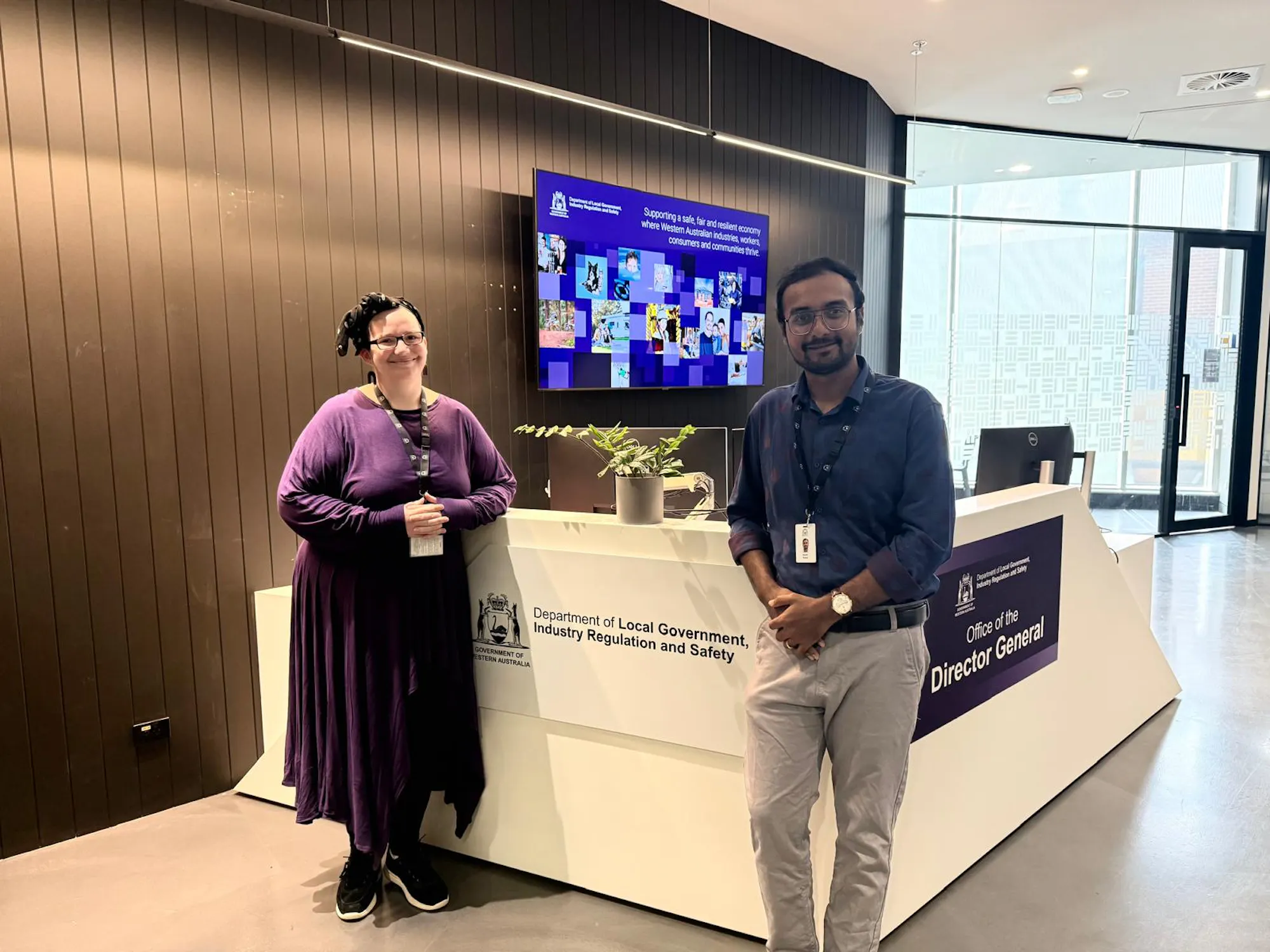
UWA Master of Business Analytics student Md Mehabub Rahat Akash applied his technical expertise to deliver meaningful impact during his McCusker Centre for Citizenship internship with the Department of Local Government, Industry Regulation and Safety (LGIRS).
Akash was placed within the Racing, Gaming and Liquor directorate at LGIRS, working in the Cross Sector Triage Team.
He said he applied for a McCusker Centre internship to gain hands-on experience and apply his academic learning in a real organisational environment. He was particularly interested in contributing to a project that delivered meaningful benefits to the community.
During his internship Akash worked on data analysis, reporting and improving how information is structured for decision-making. He organised and integrated data from multiple sources, supported analytical tasks, and contributed to the development of a Power BI dashboard focused on alcohol-related harms.
The dashboard includes trend analysis and comparisons across local communities and broader Western Australian benchmarks and supports future integration of liquor restriction data to assess its impact.
His supervisor highlighted the significance of his contribution to a complex, cross-agency initiative.
“Akash has made a genuinely meaningful contribution in developing an analysis and risk monitoring data dashboard… designed to support proactive, evidence-based regulation across Western Australia,” a General Manager noted.
“He demonstrated a strong ability to translate fragmented datasets and policy objectives into a coherent analytical framework… The quality of his work and the maturity of his approach were outstanding for an intern, and his contribution will have a lasting impact.”
Akash found it particularly rewarding to contribute to work with real-world application, seeing how analytical thinking can support informed decisions in a professional setting.
“The most rewarding part of my internship has been contributing to work that has practical value,” he said. “It has been fulfilling to see how structured problem-solving supports better decision-making.”
Adjusting to a professional environment and working with real organisational data presented challenges, particularly in balancing technical accuracy with business context. However, these experiences strengthened his attention to detail, adaptability and confidence in collaboration.
His supervisor also praised his professionalism and impact on the wider team.
“Akash has gone above and beyond… contributing instrumental understandings of the datasets and increasing the skills and knowledge base of his colleagues,” she said.
“He is an absolute delight to work with and has handled an incredibly complex project with professionalism throughout.”
Through the internship, Akash gained a deeper appreciation of the importance of communication, collaboration and the ability to present insights clearly. He said the experience reinforced that technical skills alone are not enough—interpreting and communicating data effectively is just as critical.
While much of his work occurred behind the scenes, Akash recognised its broader community impact. By improving data processes and supporting evidence-based insights, his work contributes to stronger regulatory decision-making and better outcomes for Western Australian communities.
“This work supports organisations to operate more effectively and make informed decisions, which ultimately benefits the public,” he said.
Akash believes the internship has strengthened his professional confidence and given him a clearer understanding of how analytics is applied in practice.
“I’ve developed communication skills, learned how to work with stakeholders, and connected my academic knowledge with practical outcomes,” he said.
He strongly recommends a McCusker Centre for Citizenship internship to other students.
“It’s a valuable opportunity to gain real-world experience, build confidence and better understand how your studies apply outside the classroom,” he said.
“It helps you grow, expand your network, and clarify your career direction.”