
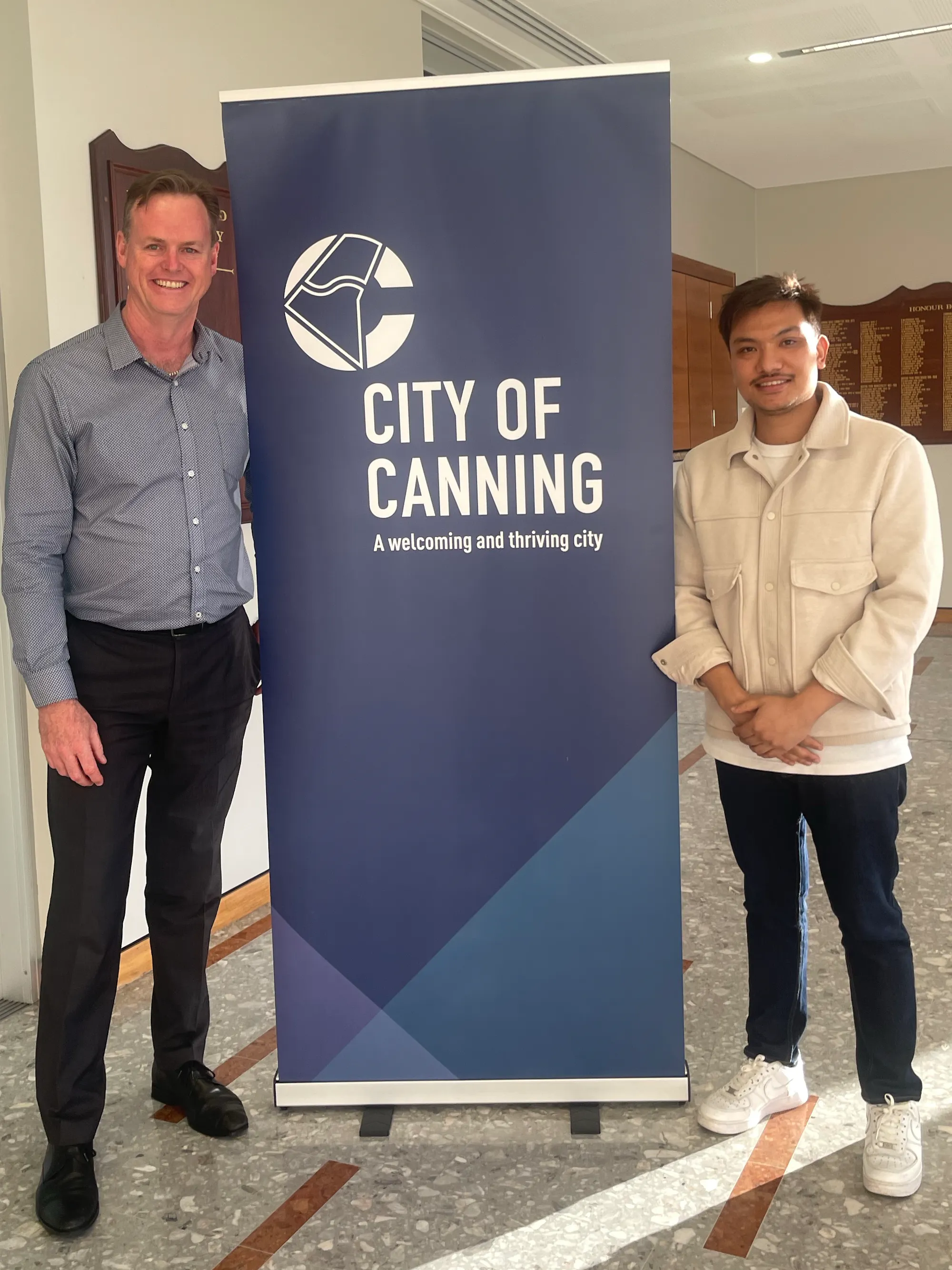
Barun Chhetri – UWA Master of Business Analytics student
Community Engagement and Strategic Development Intern, City of Canning
When Barun Chhetri began his internship with the City of Canning, he stepped into work that was both complex and unfinished. The Cannington District Leadership Group (DLG) — a collaboration of local governments, state agencies and community organisations — had a clear purpose, but no consistent structure to guide its work or bring its priorities into focus.
Barun’s role was to help change that.
Before coming to Australia, Barun had worked on community coordination and government partnerships in Nepal, so the opportunity felt familiar, but different.
“When I came across the McCusker Centre for Citizenship internship, it felt like a natural fit,” he said. “It was a chance to do the kind of work I understood, but in a completely new system.”
Working across four local governments (the Cities of Canning, Belmont, South Perth, and the Town of Victoria Park) and multiple agencies, Barun focused on two connected pieces of work: refining how the DLG operates and helping define what it should prioritise.
In practice, this meant reviewing the group’s Terms of Reference — the document that sets out how decisions are made — and identifying gaps that were limiting its effectiveness. He then worked directly with members to recommend improvements.
At the same time, Barun led engagement workshops with local government representatives and not-for-profit organisations to better understand what communities were experiencing. These conversations brought together frontline insights on issues such as housing stress, community safety and access to services.
He then translated those discussions into a district-wide strategy, giving the group a shared set of priorities and a clearer way to work together.
“The governance update gives the group the structure to act, and the strategy gives it something to act on,” Barun said.
For his supervisor, Director Community and Place Garry Fisher, the impact of the work was clear.
“There was no mechanism to really understand what was happening on the ground,” he said. “Barun engaged directly with the sector and brought that together into a strategy that the whole leadership group could agree on. It was very impactful.”
While Barun’s work was largely behind the scenes, its effects extend beyond the organisation. Stronger coordination between agencies and clearer priorities mean services can respond more effectively to local needs — particularly for people experiencing housing pressure, social isolation, or barriers to support.
“The value of the work is not that I was involved in it,” Barun said. “It’s that it will continue to be used.”
The role also pushed Barun to quickly adapt to a new environment. Arriving with no prior knowledge of the Cannington region, he needed to build local understanding while preparing to facilitate workshops with experienced professionals.
“Getting up to speed on the local context was essential,” he said. “You’re working with people who have years of experience, so you need to understand enough to guide the process in a meaningful way.”
Garry noted how Barun approached that challenge.
“He was very organised and methodical,” he said. “He would check in regularly, clarify expectations, and take feedback on board straight away. By the end, he was confidently presenting to groups across government and the community sector.”
The experience also shaped how Barun sees the role of local government.
“Local councils are closest to the community, but they don’t always have the ability to act on everything they see,” he said. “What I learned is that when coordination is done well, they can bring the whole system together around shared priorities.”
For Barun, the internship confirmed that his skills — from facilitation to stakeholder engagement — are transferable across contexts and can contribute to real-world outcomes.
He encourages other students to consider the program, particularly those looking to apply their skills in a practical, community-focused setting.
“This isn’t simulated work,” he said. “You’re contributing to something real, and that’s what makes it worthwhile.”