
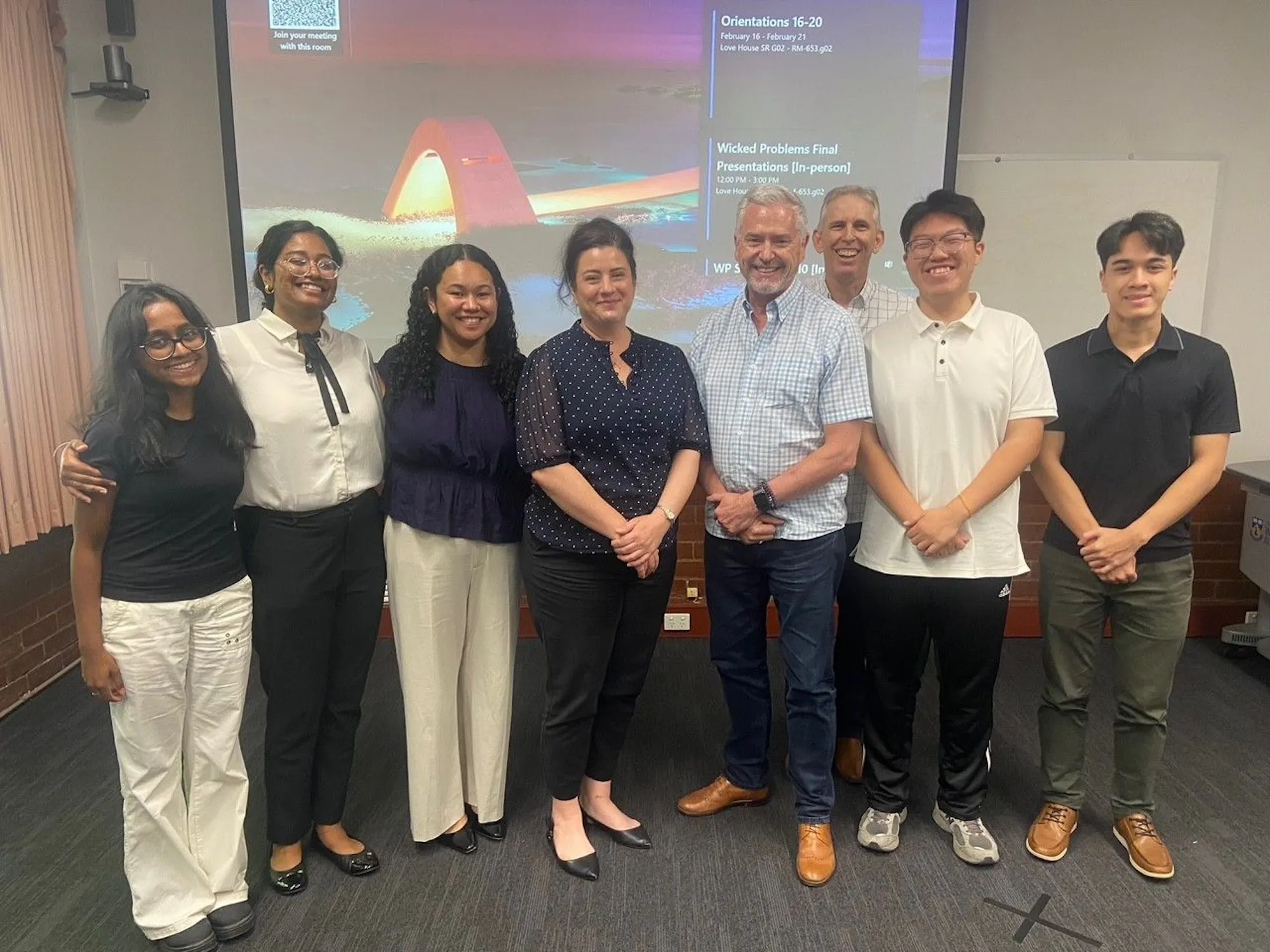
A group of UWA students partnered with Uniting WA this summer through the McCusker Centre for Citizenship’s (the Centre) Approaches to Wicked Problems unit, developing practical ideas to support older women experiencing homelessness to transition toward stability, independence and community participation.
The project formed part of the Centre’s summer intensive unit, in which undergraduate and postgraduate students work in interdisciplinary teams alongside community, not‑for‑profit and government partners to address complex social challenges. In 2026, the unit focused on the growing and often hidden issue of homelessness among older women in Western Australia.
Working closely with Uniting WA staff and drawing on frontline insights from the organisation’s Tranby Engagement Hub, the student team examined gaps that can emerge as people move from transitional housing toward longer‑term stability. Their project explored how practical skill‑building opportunities could complement existing case management supports.
The students developed a detailed proposal for a structured workshop program designed to help people experiencing homelessness build confidence, digital literacy and job readiness. The proposal included clearly defined workshop topics, learning objectives and flexible delivery approaches that could be realistically implemented within homelessness service environments.
Alongside the workshop model, students produced a draft participant resource booklet and a mock‑up digital resource hub, offering accessible tools linked to employability, communication skills and everyday digital tasks. Throughout the project, the team was mindful of trauma‑informed practice, ensuring resources were simple, engaging and adaptable for participants with varying levels of digital access or confidence.
Erin Tunnicliffe, Senior Manager – Transitional Housing Support at Uniting WA, said the collaboration provided both practical value and space for reflective thinking.
“Partnering with the Centre and students gave us the opportunity to step back from day‑to‑day operational demands and think more deeply about how services can strengthen pathways toward independence,” she said.
“The students brought fresh, multidisciplinary perspectives to a complex issue and developed proposals that were thoughtful, practical and grounded in the realities of homelessness services.”
She noted that the students’ work aligned strongly with Uniting WA’s values around dignity, inclusion and community participation.
“What stood out was their focus on implementation and their understanding of the complexity people face when exiting homelessness. The project demonstrated how structured learning and skill‑building could support confidence, agency and longer‑term stability.”
For students, the project offered a powerful opportunity to apply theory to real‑world contexts while developing skills essential for active citizenship, including systems thinking, collaboration across disciplines, empathy and stakeholder engagement.
One student reflected that visiting the Tranby Engagement Hub and engaging with people who experience homelessness fundamentally changed their understanding and awareness.
“Listening to frontline staff and a person using the service humanised the issue and highlighted the importance of dignity, confidence and emotional support,” the student said. “It showed us that meaningful solutions come from listening first.”
The Approaches to Wicked Problems unit is a core component of UWA’s Minor in Active Citizenship, which equips students to engage thoughtfully and responsibly with complex social challenges. By working alongside organisations such as Uniting WA, students gain hands‑on experience while contributing ideas that can support community‑led change.
Ms Tunnicliffe said partnerships like this also help build capability beyond the immediate project.
“Engaging students in real‑world challenges helps strengthen the broader ecosystem of people and organisations committed to addressing social disadvantage. The care, curiosity and courage we saw in this cohort gives me great confidence in the next generation entering our sector.”
Image: Dinhara Jayawardena, Gayathri Nair, Keighlee Burkhardt, Erin Tunnicliffe (project supervisor, Uniting WA), Michael Chester (Co‑Chief Executive Officer, Uniting WA), Francis Lynch (The McCusker Centre for Citizenship Academic Coordinator), Joshua Chai, Rayhan Sayyidina (left to right).